Back
Categories
Best Time to Post on Instagram in 2026
Marion Carneiro
The best times to post on Instagram are not the ones you read everywhere: they are yours. Here are benchmark slots by day and format, plus the Insights method to find your real audience peaks in 5 minutes.
You are looking for "the best time to post on Instagram".
Spoiler: there isn't one.
At least, not a universal one. The best time for your account is when your audience is online. Not the audience of an American B2B SaaS account in a study published by a US scheduling company. Yours. The people who read you, comment, save your posts and sometimes end up in your DMs.
This guide gives you two things: benchmark slots that work for most French-speaking accounts in 2026 (to use when you are starting out and don't have data yet), and above all the method to find YOUR real peaks in Insights in five minutes. That is what makes the difference.
When is the best time to post on Instagram? (overview)
The short answer for French-speaking accounts in 2026: between 11am and 1pm on weekdays, and between 7pm and 9pm in the evening. These two windows match the lunch break and the end of the workday, two moments when people scroll Instagram heavily on mobile.
The best days for most accounts are Tuesday, Wednesday and Thursday. Weekends generate more passive scrolling (so more views) but less active engagement (so fewer comments and DMs). Monday is the weakest: people are getting back into their week and scroll less.
These averages are starting points, not the truth. A B2B coach targeting founders will see peaks at 7am and 10pm. A mainstream food brand will peak on Saturday at 6pm. A creator who talks to students will peak at 11pm. The general rule applies to nobody in particular.
Best days and times to post on Instagram
The benchmark table to get started, based on aggregated data from French-speaking B2C and B2B accounts in 2026.
Day | Best slot | Second slot | Engagement level |
|---|---|---|---|
Monday | 12pm to 2pm | 7pm to 9pm | Low |
Tuesday | 11am to 1pm | 7pm to 9pm | High |
Wednesday | 11am to 1pm | 7pm to 9pm | High |
Thursday | 12pm to 2pm | 6pm to 8pm | High |
Friday | 12pm to 2pm | 5pm to 7pm | Medium |
Saturday | 10am to 12pm | 6pm to 8pm | Medium (passive scrolling) |
Sunday | 11am to 1pm | 7pm to 9pm | Medium |
How to read this table. The "best slot" combines view volume with engagement quality (comments, saves, shares). The "second slot" is an alternative window if the first one doesn't suit you. The engagement level reflects how likely the audience is to interact, not just to scroll.
These windows are in Paris time (UTC+1 / UTC+2). If your audience is mostly in another time zone, such as Quebec or Switzerland, or spread across several time zones, you need to adjust (and that is exactly what Insights is for, as we will see).
Best times to post by content type
Not every Instagram format follows the same logic. Here are the nuances that matter in 2026.
Reels. Reels are shown to an audience well beyond your followers (a cold audience). The algorithm pushes them over 24 to 72 hours, so the posting time matters less than for a post. The ideal window is still between 6pm and 9pm, when people scroll passively and are more willing to swipe. Avoid posting a Reel at 3am: the first 30 minutes after posting still shape how it is distributed, even for a long-lived format.
Photo posts and carousels. These are shown mainly to your existing (warm) audience, so timing is critical: you need to post when your followers are most present. For most French-speaking accounts, that is 11am to 1pm or 7pm to 9pm. This is where the Insights method will make the biggest difference.
Stories. They last 24 hours, but 80% of views come in the first 4 hours, so timing is crucial. The peaks: 7am to 9am (first check of the morning on mobile), 12pm to 2pm (lunch break), 8pm to 10pm (on the couch or in bed). Three Stories spread across the day reach your whole active audience.
Lives. With Lives, your audience adapts to you, not the other way around, but only if you announce them 24 to 48 hours in advance. Without preparation, aim for Wednesday or Thursday at 8pm or 9pm, when your audience is most mentally available.
Why timing matters
Three algorithm mechanisms make posting time critical on Instagram in 2026.
The initial boost in the first 30 minutes.
When you post, Instagram shows your content to a small sample of your audience to test its quality. This is called the test bowl. The engagement rate in this sample during the first 30 minutes (likes, comments, saves, time spent) determines whether Instagram pushes your content more widely or lets it die.
If you post when your audience is offline, the test bowl doesn't get enough positive signals in 30 minutes. The algorithm concludes that the content isn't interesting and stops distributing it.
In practice, a post published at 3am will reach 30% fewer people than the same post published at noon, with the same audience and quality. This is not a myth: it follows directly from how the algorithm works.
The active engagement signal.
Instagram gives much more weight to active interactions (comments, saves, DM shares) than to passive ones (likes, views). Posting when your audience is not just online but active (willing to comment) multiplies this signal.
The gap between "online" and "active" is crucial. Someone scrolling Instagram in bed at 11pm won't comment. Someone checking their phone during their lunch break will. The best timing targets your active audience, not just the people who are present.
Fast decay.
In 2026, an Instagram post loses 80% of its potential reach after 6 hours. A Reel after 48 hours. A Story after 4 hours. Posting at the wrong time means missing the window, and there is no way to catch up.
To understand how these signals interact in the algorithm, we broke down the whole mechanism here: the Instagram algorithm in 2026.
Find YOUR real peaks with Instagram Insights (step by step)
This is the part that changes everything. Benchmark slots are starting points. YOUR audience's peaks are the real answer, and Instagram gives them to you for free in Insights. Here is how to read them.
Step 1. Switch to a professional account.
If you still have a personal account, you don't have access to Insights. Go to your profile, open the menu (Settings and activity), then "For professionals" and "Switch to professional account". Choose "Creator" if you work alone or "Business" if you represent a brand. It is free, with no commitment, and you can switch back at any time.
Step 2. Open Insights.
On your profile, tap the Professional dashboard or Insights button (just below your bio). You land on the dashboard.
Step 3. Go to "Total followers".
Scroll down to the "Total followers" section and tap it to open the details. You will see several sub-sections: locations, age range, gender, and the one we care about: Most active times.
Step 4. Read the "Most active times" chart.
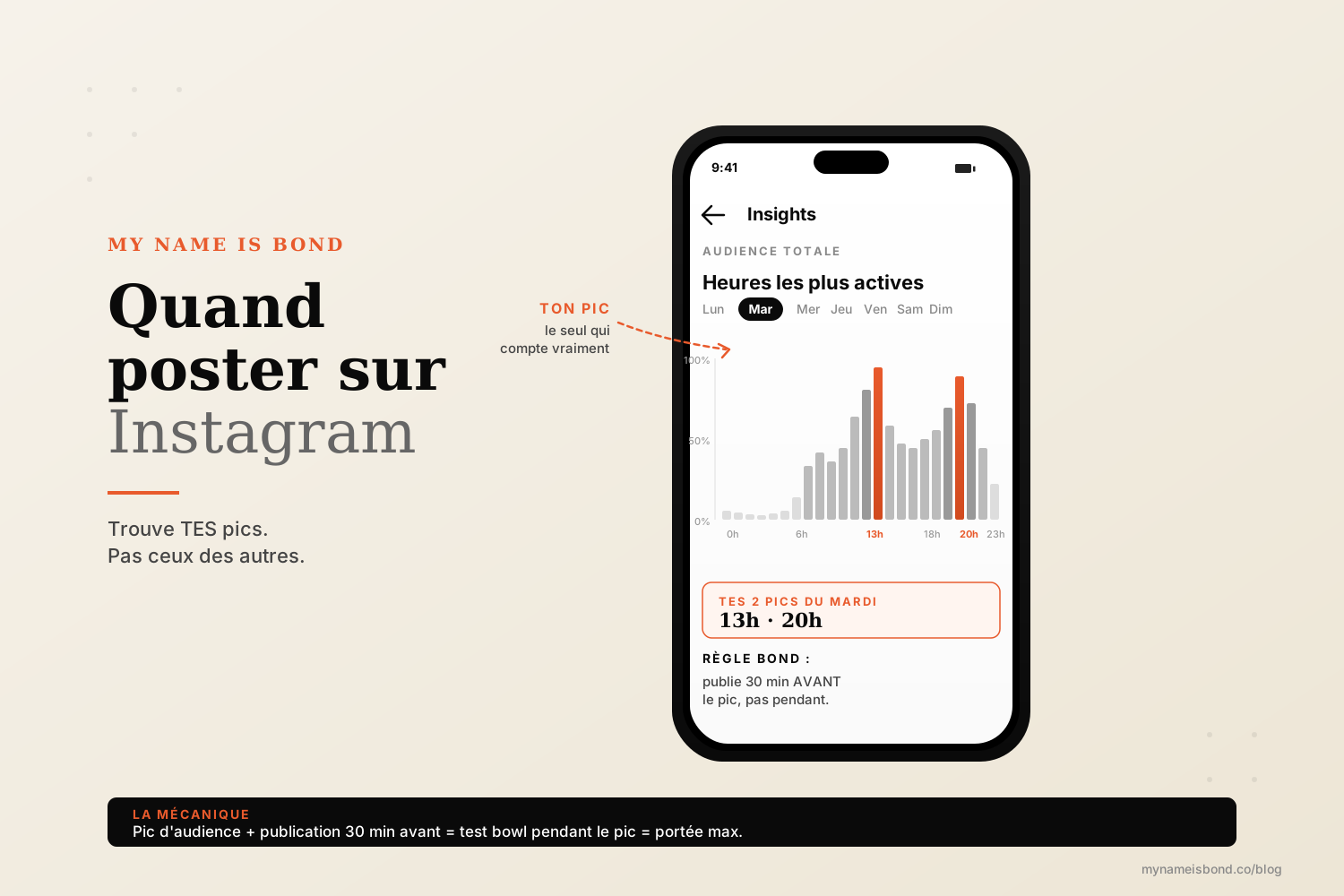
The chart shows, as vertical bars, when your followers are online, day by day. You can switch between days (Monday, Tuesday, Wednesday...). The peaks are your real slots.
What to look at:
The two highest bars each day: these are your absolute peaks.
Consistency across days: if you have a peak at 1pm on Monday and 12pm on Tuesday, your lunchtime slot is solid.
Gaps: if an hour is empty, never post then.
Step 5. Build your posting schedule.
From the 7 daily charts (one per day of the week), build a schedule. One post per day, scheduled 30 to 60 minutes before the peak (not during it). Why before? Because you want your post to already be served and collecting engagement when the peak starts, not to come out of the oven just as everyone is scrolling.
A concrete example: if your Tuesday peak is 1pm, post at 12:15pm or 12:30pm. The test bowl will run between 12:30pm and 1pm, just as your audience arrives in large numbers. Maximum boost.
Step 6. Repeat every 30 days.
An account's audience changes. Redo this exercise every month. To go further, we wrote the complete guide to analyzing your account here: analyze your Instagram account in 8 key steps.
How often to post, and scheduling
Once you have your peaks, two questions remain: how often to post, and whether to schedule.
Recommended frequency in 2026:
Photo posts and carousels: 2 to 4 per week. Beyond that, you saturate your audience and compete with your own reach (the algorithm limits how often the same account appears in a user's feed).
Reels: 3 to 5 per week. Reels have a long lifespan (48 to 72 hours) and reach people outside your audience, so you don't saturate your followers.
Stories: 3 to 8 per day. No more than 10, or people skip halfway through.
Scheduling.
Scheduling through Meta Business Suite, Buffer, Later, Metricool or Notion with an integration carries no algorithm penalty in 2026, despite rumors in previous years. Instagram does not penalize posts scheduled through official tools.
Our recommendation: schedule Reels and carousels (a huge time saver) but post Stories manually (spontaneity still works better in this format, and you can adapt to the news of the day).
And one solid tip: always keep 20% of your posts manual, so you can react to a trend, news in your industry or a cultural moment. Scheduling 100% of your content makes a brand feel robotic.
If you want us to take this work off your hands (Insights audit, posting schedule, production), that is what we do in Instagram strategy.
FAQ
What is the best day to post on Instagram?
For most French-speaking accounts in 2026, the best days are Tuesday, Wednesday and Thursday. These are the days with the highest active engagement (comments, saves, DM shares). Monday is the weakest (people are getting back into their week and have less time). Weekends generate a lot of passive scrolling but fewer interactions. That said, your real best day depends on your specific audience: use your account's Insights to find your actual peaks.
Should you post on Instagram every day?
No, it is not necessary in 2026. The recommended frequency is 2 to 4 photo posts or carousels per week and 3 to 5 Reels per week. Posting every day can even reduce your reach, because the algorithm limits how often the same account appears in a user's feed. Consistency matters more than raw frequency: posting 3 times a week for 6 months is better than posting 7 times a week for 3 weeks and then disappearing. For Stories, however, posting daily is still recommended (3 to 8 Stories per day).
How can I see when my followers are online?
You need a professional account (Creator or Business, free). Go to your profile, tap Insights (or Professional dashboard), then scroll down to "Total followers". Open it and look for the Most active times chart. You can switch between days of the week to see your daily peaks. Post 30 to 60 minutes before each peak to get the most out of the algorithm's initial test bowl.
What time should you post a Reel?
For a Reel, the benchmark slot is between 6pm and 9pm, a window of passive scrolling when people are most willing to swipe. That said, because Reels have a long lifespan (48 to 72 hours, shown to a cold audience beyond your followers), the posting time matters less than for a standard photo post. Just avoid off-peak hours (1am to 6am), which hurt the first 30 minutes of the test bowl. For a Reel, the angle, the hook and retention matter 10 times more than the exact time.

Instagram growth
securely and simply.
Save time.
Acquire new customers.
Boost your growth now.