Back
Categories
tiktok
How to Grow on TikTok in 2026
Marion Carneiro
Growing on TikTok has nothing to do with luck or buzz. It follows clear mechanics the algorithm rewards, whether you start with 0 or 10,000 followers. Here is the 7-step method, plus the shortcut if you want to move faster.
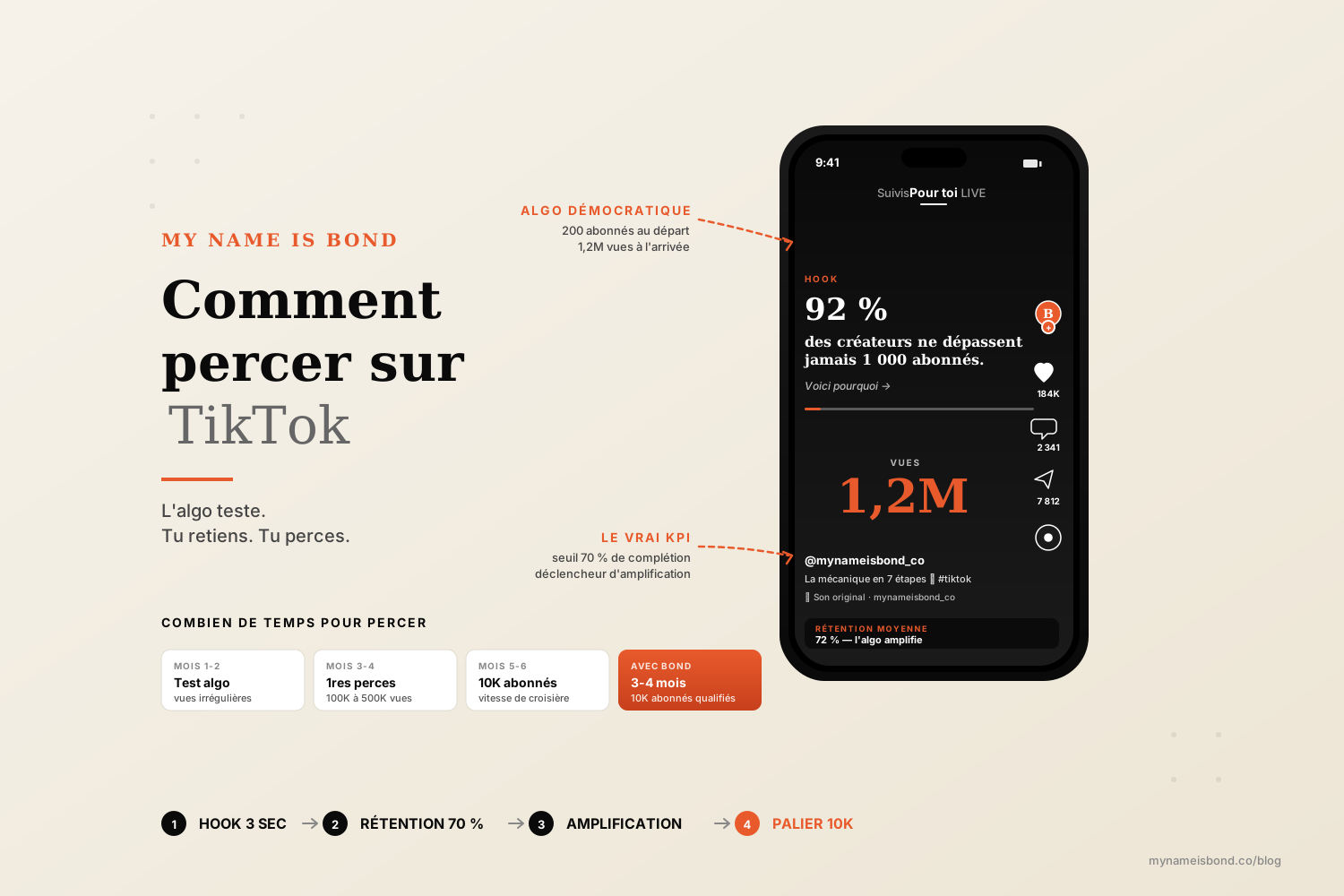
An account with zero followers gets 3 million views overnight.
On TikTok, this is not an exception. It is how the algorithm normally works.
TikTok is the only network where account size does not determine reach. In 2026, an account created last week can outperform an account with 500,000 followers on the same topic, as long as its content ticks the right boxes for the algorithm. This built-in fairness is what makes the platform so competitive and so promising for new creators.
Growing on TikTok is not a matter of luck, though. It is a discipline you can manage. This guide covers the 7 concrete steps that separate accounts that take off from those that stall: niche, hook, retention, trends, consistency, community and iteration. At the end, you will also find the shortcut if you want to speed up what organic growth usually takes 4 to 6 months to achieve on its own.
What "growing on TikTok" actually means
Three definitions are commonly used, and mixing them up wastes your time.
Definition 1: the viral video.
One or more videos pass 1 million views. It is spectacular, but often short-lived. A viral TikTok video does not automatically turn into followers, business or authority. It produces a spike in reach that fades within 48 to 72 hours.
Definition 2: follower growth.
Your account goes from 200 to 20,000 followers in a few weeks. This is the definition most people associate with "making it". It is more solid than a viral video because it shows that your content convinces people beyond a single scroll.
Definition 3: a community that engages and buys.
You build an audience that knows you, comments, follows you on other channels and buys what you offer. For a business account, this is the only definition that counts. The first two are of little use without the third.
At Bond, we consider that an account has taken off when:
It regularly gets more than 10,000 views per video (not just once a month).
It gains at least 1,000 new followers a month at a steady pace.
It generates qualified inbound DMs or traffic to an offer.
Aim for this combination, rather than a single viral video or a race for empty followers.
The good news: TikTok does not reward the biggest accounts
This is what makes TikTok so different from Instagram, YouTube or Facebook. The algorithm gives little weight to the size of the account posting.
How it works.
When you post a video, TikTok sends it to a first sample of 100 to 500 users and watches how they behave:
Completion rate: how many watch to the end?
Average retention time: how many seconds on average?
Replay rate: how many watch it twice?
Signals of intent: likes, shares, comments, saves.
If the signals are good, it pushes the video to a larger sample (5,000 to 50,000). If it keeps performing, it widens again (100,000 to 1,000,000), and so on, with no fixed ceiling.
Your follower count plays a very small role in this process. An account with 500,000 followers that posts a poorly calibrated video can get 3,000 views. An account with 200 followers that posts content that holds attention can get 2 million.
The strategic consequence.
You cannot use your "small size" to explain a lack of reach. The algorithm does not discriminate against you. It is simply waiting for you to post something it can test, and if the content is good, it amplifies it every time.
This makes TikTok both very profitable (you can take off with 0 followers) and very demanding (there is no excuse for weak content). The 7 steps below are what separate content that triggers amplification from content that stays in the first sample.
Step 1: define a clear audience and niche
This is the step most creators skip, and it is also the first reason they fail.
Posting "about everything" is the fastest way to reach nobody. The TikTok algorithm works through implicit categorization: it looks at who interacts with you and on which topics, then pushes your next videos to similar audiences. If you change topics with every video, the algorithm cannot place you, does not know who to show you to, and your reach collapses.
How to define your niche in 2026.
Three questions.
Who exactly do you want to serve? Rather than "entrepreneurs", say "female coaching founders who want to go from 0 to €5K a month." Be as precise as possible.
What unique angle do you bring? Rather than "marketing", say "the carousel method that brings in DMs without posting more than 3 times a week."
What gives you credibility? Your experience, your profession, your certification, your years in the field. Your opinion alone is not enough. An angle without credibility does not hold attention.
Once you have written these 3 answers, they should fit in one sentence your grandmother could understand: "I make videos that help [audience] achieve [result] with [method]." If you cannot write that sentence, your niche is not clear yet.
Step 2: master the hook (the first 3 seconds)
On TikTok in 2026, a user takes 300 milliseconds to decide whether to stay or swipe. If you lose those 300 milliseconds, the rest of your video is ignored.
So the first 3 seconds have a specific job to do:
Create immediate tension (curiosity, surprise, a promise).
State the topic clearly so people know whether it concerns them.
Give a strong visual signal (movement, large text, a change of pace).
5 hooks that perform in 2026.
The bare number. "92% of creators never get past 1,000 followers. Here's why." A number plus a promise of explanation holds attention.
The counterintuitive statement. "Stop posting every day on TikTok. It does nothing." Contradicting what everyone thinks grabs attention.
The targeted call-out. "If you're a business coach struggling to reach 1,000 followers, this video is for you." Direct identification filters in your target audience.
The pointed question. "Do you ask your clients this question? Stop. Here's why." Addressing people directly creates an emotional connection.
The instant visual demo. Show a before and after in 2 seconds, without a word. A silent demo is often more effective than a voiceover.
Mistakes to avoid in 2026.
"Hi everyone, today I'm going to talk about..." (you lose everyone).
Your logo, opening animation or bumper. Nobody scrolling knows you yet. These elements lose your audience before they even understand the topic.
A vague hook ("I'm going to tell you everything about..."). Nothing specific means a swipe.
The hook is 80% of the work. The rest of the video only gets watched if the hook is good.
Step 3: focus on retention rather than views
This is the most important principle for understanding TikTok in 2026.
TikTok rewards time spent rather than views. A 15-second video watched in full by 1,000 people is worth more to the algorithm than a 60-second video watched at 20% by 10,000 people.
Target: at least 70% completion.
This retention threshold is what separates videos that are pushed to a second sample (10x, 50x, 100x the reach) from those that stay stuck in the first.
3 ways to hold attention in 2026.
1. Tight pacing.
Make a cut every 2 to 4 seconds. A shot that lasts more than 4 seconds makes people swipe. Use Instagram Edits (or CapCut, DaVinci) to systematically cut dead time: pauses, hesitations, verbal transitions.
2. Ongoing teasers.
Every sentence should make people want to stay for the next one. Techniques:
"The third point is the one nobody mentions."
"Wait until the end, you'll see why."
"What comes next changes everything."
These small cliffhangers keep people engaged second after second.
3. A satisfying ending.
Many creators just trail off ("so yeah, bye"). That is a mistake. The ending should bring a twist, a resolution or a strong CTA. Otherwise people leave before the end and your completion rate drops.
Analyze your retention in TikTok Analytics.
The app shows a curve with your retention rate second by second. Look at it for your last 10 videos and find where people drop off. At second 3? Your hook is weak. At second 15? Your transition is not working. At the end? Your CTA is not engaging. This is a goldmine of information for your next videos.
Step 4: ride trends and the right sounds
A TikTok that uses a trending sound gets an automatic boost from the algorithm. It is not a guarantee, but it is a multiplier.
How to spot trending sounds.
Three reliable methods in 2026.
The "Create" tab, then "Add sound" in TikTok. Sounds marked with a small upward arrow are growing fast.
TikTok's Creative Center (part of TikTok for Business) shows trending sounds by region and category, updated regularly.
Your own monitoring. Spend 15 minutes a day on your For You feed as a regular viewer. Note the sounds that come up more than 3 times in the same session. Those are the sounds of the moment.
The timing rule.
A sound can be used for 7 to 14 days at the peak of a trend. After that, it is saturated and loses its boosting effect. Before that, it is not yet mainstream and does not trigger amplification.
Adapt rather than copy.
The classic mistake is copying a trend exactly. Your content should use the trend's mechanics within your niche. If the trend is a "point of view plus twist" format, use that format with a business topic if you are a coach, or a cooking topic if you are a chef.
Trends are story structures, so put your own angle into the structure.
Step 5: post consistently
Posting one video a week is not enough in 2026.
The recommended pace to take off:
Beginner (0 to 5,000 followers): 1 to 2 videos a day, at minimum.
Growing (5,000 to 50,000): 5 to 10 videos a week.
Established (50,000+): 3 to 5 videos a week, with more polished production.
Why this frequency.
The TikTok algorithm rewards continuous presence. The more you post, the more data it has about who you are and who watches you. An account that posts 30 videos in 30 days gives the algorithm 30 times more information than an account that posts 3.
The trap to avoid.
Posting a lot does not mean posting anything. Every video still has to pass the hook and retention test. If you rush to keep up the pace, you lose on both fronts: poor reach and an audience that gets tired of you.
Bond's system to keep up the pace.
A 3-hour batch session each week where you film 5 to 10 videos in one go. You edit them over the next 2 days and publish them throughout the week. You do not wear yourself out posting live every day, and you keep your energy for quality.
Step 6: engage your community (replies, Duets, LIVEs)
Posting is not enough. TikTok rewards creators who are present in their community.
Three habits to build:
1. Reply to every comment within 24 hours of posting.
Each reply is a strong signal. TikTok sees the creator's engagement as a sign of content quality. Bonus: you can reply to a comment with a dedicated video (the "Reply with video" feature). These videos often perform better than regular posts because they come with built-in context.
2. Use Duets and Stitches.
Responding to another creator's video with a Duet or a Stitch puts you in front of their audience. If you Duet a bigger creator (with content that adds value rather than piggybacking), you attract part of their community. It is one of the most underused levers in 2026.
3. Go LIVE regularly.
TikTok LIVE gives a significant boost to accounts that go live regularly (2 to 3 times a week). Even with 10 viewers, these LIVEs tell the platform you are an active, engaged creator. They also deepen your relationship with your real fans, which then shows up as comments and shares on your posts.
Step 7: analyze your performance and iterate
This is the difference between a creator who improves and one who keeps repeating the same mistakes.
Open TikTok Analytics (free with a Creator or Business account) every week.
Look at:
Your 3 best-performing videos of the month. What do they have in common? Topic, format, hook, length, posting day?
Your 3 worst-performing videos. Same exercise in reverse.
Your average completion rate. Is it going up, down or staying flat?
When your audience is most active. Post at that time.
Your traffic sources (For You, profile, search, shares). When an account starts performing, "Search" and "Profile" go up: a sign that your brand is becoming a destination people look for, beyond the feed.
The iteration log.
A simple Google Doc or Notion page where you write down each week:
1 thing that worked.
1 thing that did not work.
1 hypothesis to test the following week.
This discipline separates creators who take off in 3 months from those who stall for 12. Talent has less to do with it than the rigor of your iteration.
How long does it take to grow on TikTok?
This is the most common question. Here is an honest answer for 2026, based on the accounts we observe and support:
For an account that correctly applies the 7 steps above (clear niche, well-worked hooks, at least 1 video a day):
Months 1 to 2: the algorithm's test period. Views are irregular. Some videos get 200 views, others 20,000, without you understanding why. This is normal: the algorithm is learning how to categorize you.
Months 3 to 4: your first videos take off (100,000 to 500,000 views). Follower growth starts. You go from 200 to 3,000 followers on average.
Months 5 to 6: the algorithm recognizes your niche. You reach a steady pace (10,000 to 50,000 views per video) and pass 10,000 followers.
Months 7 to 12: 50,000 to 100,000 followers is within reach if you keep up the pace and iterate on the patterns that work.
For an account that posts 1 video a week without working on the mechanics:
12 to 18 months to reach the same milestones, and often never.
For an account supported by a team that handles production, strategy and analysis:
3 to 4 months to reach 10,000 qualified followers.
6 to 8 months to pass 100,000 followers.
The difference between these timelines has nothing to do with magic. It comes from execution density (faster production) and quality of analysis (more rigorous iteration).
Speed things up with an agency (the Bond approach)
You can grow on TikTok on your own. But it takes 4 to 6 months of strict discipline on average, with a lot of trial and error during months when your account does not seem to take off.
Working with a specialist team cuts this to 3 to 4 months for the same milestone, and greatly improves the quality of the followers you gain (a targeted audience rather than people chasing viral content).
What we do at Bond as part of our TikTok support:
Niche and positioning strategy. A unique angle, an editorial line and a brand tone.
Video production (scripts, filming, editing) at a guaranteed pace of 4 to 8 videos a week depending on the package.
Ongoing algorithm optimization: testing formats, adapting to trends, iterating on hooks.
Weekly analytics review with strategy adjustments.
Community management (replying to comments, qualified DMs, planned LIVEs).
Measurable results for our clients: 10,000 qualified followers reached in 3 to 4 months on average, with a conversion rate to the business offer above 5% (compared with 0.5 to 1% for unmanaged accounts).
To see the full method and whether support makes sense for you: TikTok growth.
Bond's rule: growing on TikTok follows clear mechanics. Whether you manage it alone or with a team, apply the 7 steps rigorously and the results will follow.
FAQ
How long does it take to grow on TikTok?
In 2026, an account that correctly applies the 7 steps (clear niche, well-worked hooks, at least 1 video a day, weekly iteration) usually reaches 10,000 qualified followers in 4 to 6 months. The first 2 months are the algorithm's test phase (irregular views, categorization in progress). Months 3 to 4 bring the first videos that take off (100,000 to 500,000 views). Months 5 to 6 bring a steady pace and the 10,000-follower milestone. An account that posts one video a week without a strategy usually takes 12 to 18 months to reach the same level, and often never does. An account supported by a specialist team can cut this to 3 to 4 months for the same milestone.
Do you need to post every day to grow on TikTok?
Yes, at least during the early phase. For a new account (0 to 5,000 followers), the recommended pace is 1 to 2 videos a day. The TikTok algorithm rewards continuous presence: the more you post, the more data it collects to categorize and distribute your content. An account that posts 30 videos in 30 days gives the algorithm 30 times more information than one that posts 3 times a month. Be careful: posting a lot does not mean posting anything. Every video still has to pass the test of a solid hook and good retention. From 50,000 followers, you can drop to 3 to 5 videos a week with more polished production. Below that, frequency matters more than highly polished production.
Can you grow on TikTok without showing your face?
Yes, but it is harder. Several faceless formats work in 2026: voiceover over illustrative footage, tutorials showing hands and a screen, animation or motion design, ASMR or nature content, storytelling with on-screen text. These formats perform well in certain niches (finance, tech, cooking, crafts). However, in niches where human connection matters (coaching, education, personal development, fashion), not showing your face limits long-term growth. Trust builds faster when the audience can see a person. If your niche does not require it and you are comfortable staying off camera, you can still grow. If your niche relies on human connection, at least use your voice and gradually add shots where you appear.
How many views does it take to go viral?
In 2026, the commonly accepted threshold for "going viral" on TikTok is 1 million views on a single video. Some stricter creators set the bar at 5 million. But aiming purely for virality is a poor strategy: a one-off viral video does not automatically turn into lasting followers, an engaged community or business. A better goal is to get consistently high views (10,000 to 100,000 views per video, several times a week), which builds a solid audience over time. An account that regularly gets 50,000 views per video generates more growth and business than an account that had one video at 3 million views followed by months of stagnation. Aim for consistency rather than a single viral video.

Instagram growth
securely and simply.
Save time.
Acquire new customers.
Boost your growth now.