Back
Categories
tiktok
How to Get More Views on TikTok in 2026
Marion Carneiro
Getting views on TikTok comes down to 10 specific methods the algorithm rewards: a strong hook, 70%+ retention, trending sounds, targeted hashtags and a steady posting pace. Here is the full breakdown, plus the trap of views that never turn into followers.
"How do I get more views on TikTok?" is probably the question creators ask most in 2026, and it is also the one most articles answer badly. Most of them repeat the same vague advice ("post regularly", "use hashtags", "polish your bio") without explaining the specific mechanics that take a video from 300 to 30,000 views.
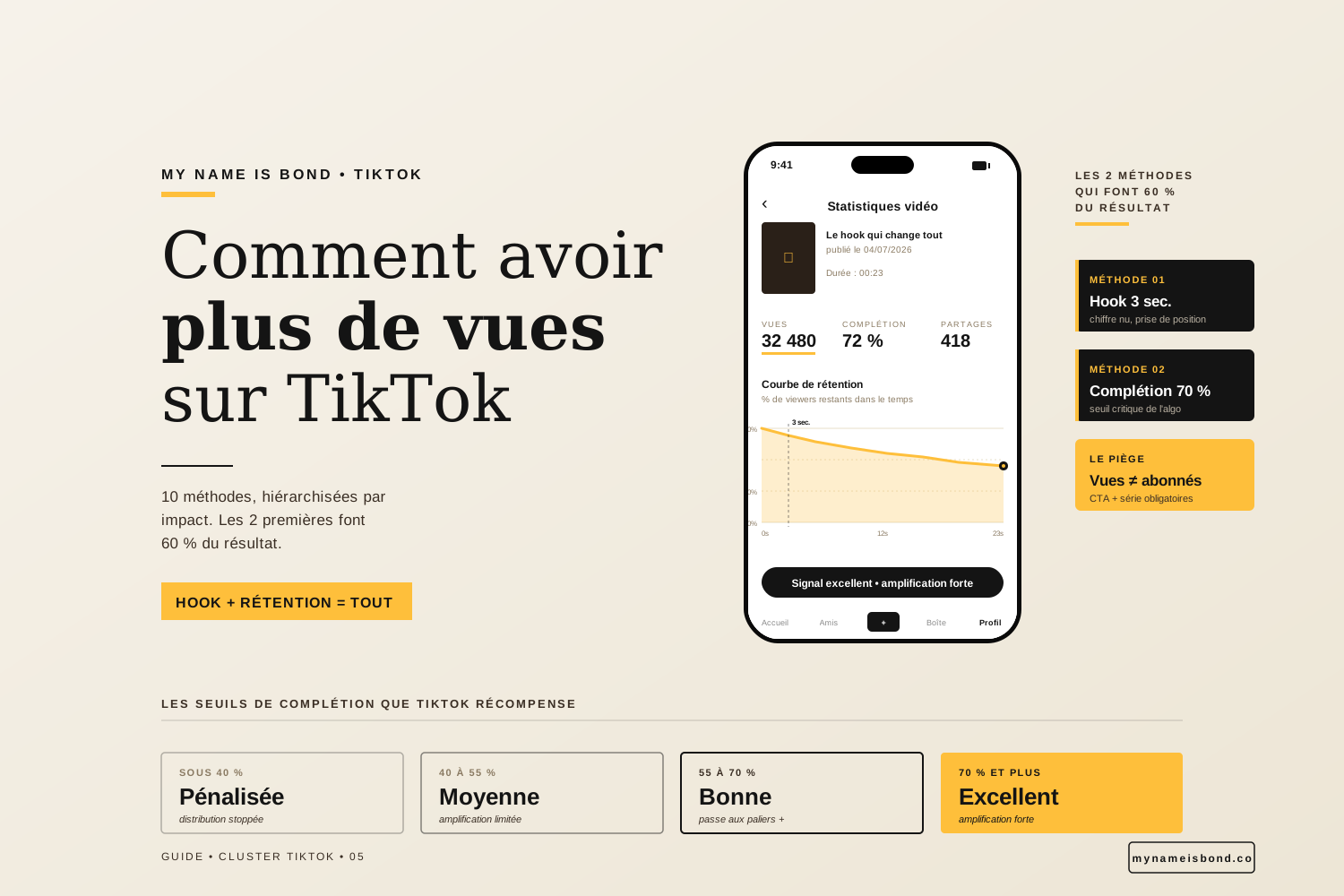
This article explains those mechanics: what really decides a video's reach, why some creators stall despite good production, and 10 concrete methods ranked by real impact (the first 2 deliver 60% of the results).
We also cover what most articles leave out: the trap of views without conversion. An account that gets 500,000 views a month without gaining qualified followers is not building anything. Views are a means to an end, and we explain how to turn them into business growth.
How TikTok decides whether to push a video
Before the methods, the basics. TikTok does not push videos at random. The algorithm works in successive test stages.
Every video you post is first sent to a small sample (100 to 500 users). On this sample, TikTok measures a set of signals: how many watch to the end, how many watch twice, how many like, comment, share or save. If the signals are good, your video moves to the next stage (5,000 to 50,000 users). If they are poor, it stays stuck at a few hundred views.
This is why an account with 87 followers can get 200,000 views on a video, and an account with 50,000 followers can stall at 800 views on its latest post. TikTok rewards signals, whatever the size of the account.
For the full mechanics of stages and signals: TikTok algorithm 2026, how it works.
Why you get so few views (common causes)
Before you start on the 10 methods, diagnose the problem. On accounts that come to Bond with a views problem, the cause is almost always one of these 5:
Cause 1: your hook is weak. If 60% of your viewers swipe away before second 3, no other method will make up for it. This is the starting point.
Cause 2: your retention drops mid-video. Completion rate collapses halfway through and TikTok stops distributing the video.
Cause 3: your niche is vague. The algorithm does not know who to show your videos to, so it shows them to the wrong people.
Cause 4: you use sounds or trends that do not fit your content. The signals contradict each other and the result is mediocre.
Cause 5: you do not post regularly enough. The algorithm does not have enough data to classify you correctly.
Check your analytics before reading the rest of this article. Find which of the 5 causes applies to you, then start with the methods that address it.
10 methods to get more views on TikTok
Ranked by impact. Methods 1 and 2 deliver 60% of the results. Do not ignore the other 8, but start there.
1. Nail the hook in the first 3 seconds
By far the highest-impact method.
On TikTok in 2026, a user decides in about 300 milliseconds whether to keep watching or swipe. Your video has 3 seconds at most to hook them. After that, you lose 60% of your potential audience.
TikTok measures retention over the first 3 seconds separately. A video that loses 60% of viewers before 3 seconds is penalized immediately, whatever happens next.
5 hook formats that work in 2026:
The bare number: "92% of creators never get past 1,000 followers."
The counterintuitive statement: "Stop posting every day. It does nothing."
The targeted call-out: "If you're a coach with fewer than 500 followers, this video is for you."
The pointed question: "Do you do this in your videos? Stop right now."
The instant visual demo: a before and after in 2 seconds, without a word.
What kills a hook:
"Hi everyone, today I'm going to talk about..." (instant loss).
A musical intro, an animated logo, a bumper.
A vague opener ("I'm going to tell you everything about...").
Your concrete lever. Spend 30 to 40% of your preparation time on the hook alone. It may look excessive, but it is the most rational use of your time.
2. Maximize your completion rate
The signal TikTok weighs most heavily.
A viewer who watches your video to the end sends TikTok a much stronger signal than 10 likes. The key thresholds in 2026:
Completion rate | What the algorithm does |
|---|---|
Under 40% | Video penalized, distribution stops |
40 to 55% | Average, limited amplification |
55 to 70% | Good, moves up to higher stages |
Over 70% | Excellent, strong amplification |
Over 90% | Exceptional signal |
Techniques that increase completion:
Tight pacing: a cut every 2 to 4 seconds, no dead time.
Ongoing teasers: "the third point is the one nobody mentions", "wait, I'll show you at the end".
On-screen text that keeps people watching ("watch what I do here").
A satisfying ending that leaves people feeling they learned or experienced something.
Your concrete lever. Open TikTok Analytics for your last 5 videos. Look at the second-by-second retention curve and find the exact moment people drop off. That is what you need to rework.
3. Use current sounds and trends
Trending sounds are a measurable distribution booster in 2026. Using a fast-growing sound gives your video an automatic reach boost.
How to find a trending sound:
Open the "Add sound" tab in TikTok's editor.
Sounds with a small green arrow next to them are growing fast.
Look for the ones accounts close to your niche started using less than a week ago.
Adapt them to your content (keep the sound, rewrite the format).
The right balance:
Do not use trending sounds 100% of the time (you lose your identity), and do not ignore them completely (you miss a booster). The rule: 1 video in 3 with a trending sound, and 2 in 3 with your original sound or a classic sound in your niche.
Be careful. A trending sound forced onto content that does not fit has the opposite effect. TikTok detects the mismatch between sound and content and distributes the video less. If the trending sound does not fit your format, do not use it.
4. Choose relevant hashtags (not too generic)
Despite what many guides still say, hashtags no longer drive performance in 2026. TikTok mainly relies on direct video analysis and the meaning of your caption to understand your content. Hashtags play a secondary role.
What works in 2026:
3 to 5 hashtags at most, precise and consistent with your content.
A mix: 1 broad hashtag (general theme), 2 or 3 niche hashtags (your specific community), and possibly 1 trending hashtag if it is really related.
Avoid: #foryou, #fyp, #viral (they add nothing, TikTok ignores them as automatic tags).
What does not work:
Stacking 25 to 30 random hashtags (a waste of time with no gain).
Using very generic hashtags unrelated to the content.
Copying another creator's hashtags without adapting them to your niche.
A concrete test. Make 2 series of videos in the same format: one with 3 precise hashtags, one with 25 random hashtags. Over 5 videos per series, the difference in reach is usually under 8%. Hashtags are marginal, so do not build your strategy on them.
5. Post at the right time
The best time depends on your audience, not on a general average.
Every "best times to post on TikTok" list is an average, and your audience may not fit it.
A reliable method to find your times:
Switch to a Creator or Business account (free, with no algorithm penalty).
Open TikTok Analytics, go to "Followers" and then "Most active times".
Find your audience's activity peaks (often 2 or 3 a day).
Post 30 to 60 minutes before each peak, so your video is already being distributed when your audience comes online.
Slots that generally perform well for French-speaking B2C accounts in 2026 (local time):
11:30 a.m. to 1 p.m. (lunch break)
6:30 p.m. to 8:30 p.m. (end of the workday)
9 p.m. to 11 p.m. (evening downtime)
Remember the rule: an excellent video posted at 3 a.m. will still take off, and a weak video posted at the best time will stall. Timing adds about 10%, it is not the main factor.
6. Write a caption that gets reactions
TikTok analyzes your caption semantically to understand what your video is about and refine its distribution. A well-written caption improves your reach in two ways: more precise categorization by the algorithm, and more comments, which send an active signal.
How to structure a caption that gets reactions:
1 to 3 sentences at most.
The first sentence includes precise keywords related to the topic (for the algorithm).
The last sentence asks for a reaction ("what do you think?", "what would you do in my place?", "reply in the comments").
No spammy emojis at the start.
A concrete example:
Weak: "New TikTok video today, hope you like it ❤️❤️❤️ #tiktok #fyp #foryou #viral"
Strong: "The hook method 92% of creators still don't use. Have you tried it?"
The second one is shorter, clearer for the algorithm and prompts comments (a strong active signal).
7. Post regularly
Consistency produces results that talent alone does not.
In 2026, an account that posts 5 times a week for 12 weeks gets far better results than one that posts 20 times in 3 weeks and then goes silent for 2 months.
Why:
The algorithm uses your successive posts to classify you (positioning, target audience, quality level). The more regularly you post, the better it understands you.
Regular posting has a compounding effect: each video benefits from the feedback on the previous ones.
Your audience learns where to find you and starts expecting your videos.
Realistic posting pace by stage:
Beginner (0 to 10,000 followers): 5 to 7 videos a week, to give the algorithm as much data as possible.
Established account (10,000 to 100,000 followers): 3 to 5 videos a week, with more care on production.
Mature account (100,000+ followers): 3 to 4 videos a week, focused on quality.
A trap to avoid. Posting every day at the start and then giving up. The algorithm has classified you on a high posting pace and distributes your videos less as soon as you slow down. Choose a pace you can keep up for 6 months.
8. Repeat the formats that work (series, rewatches)
One of the most underused methods.
Series. Posting several episodes around the same angle ("episode 1: I'm launching my brand in 30 days", "episode 2", and so on) creates a reminder effect. Each new episode brings earlier ones back into circulation. Viewers who get hooked on the first one come back on purpose to find the next.
Rewatch formats. Building some videos to trigger replays directly increases your watch time. Techniques:
On-screen text that deliberately takes longer to read than it is shown (people come back to finish reading).
A final twist that reframes the beginning and makes people want to rewatch with the new information.
A short tutorial where people want to go back to a step they missed.
A viewer who watches a 15-second video 3 times sends a signal equivalent to watching a 45-second video in full. Replays are a major algorithm booster in 2026.
9. Encourage shares and saves
DM shares and saves are the active signals TikTok weighs most heavily in 2026. A DM share is often worth more than a like on its own. A save is a promise to watch again.
Relative weight of active signals, from strongest to weakest:
DM share (sending the video to a contact): the strongest signal.
Save: very strong.
A long comment or one that starts replies: strong.
External share (WhatsApp, another network): strong.
Like: weak on its own, important in volume.
How to trigger them:
Share CTA: "Send this video to a friend who just launched their brand."
Save CTA: "Save this video, you'll need it next time you put together a carousel."
Comment CTA: "What would you do in my place? Reply in the comments."
Your concrete lever. A clear CTA often triples the rate of these actions compared with no CTA. Never skip the CTA on a video with potential.
10. Analyze your stats and iterate
The method that separates creators who grow in 6 months from those who stall for 3 years.
Look at your analytics every week. Daily is too noisy and quarterly is too late.
What to look at first:
Your 3 best-performing videos of the week. What do they have in common? Topic, format, hook, length, sound?
Your 3 worst-performing videos. Same questions in reverse.
Your videos' average completion rate. Under 40%, you are sending a negative signal to the algorithm. This is the most important metric.
Your rewatch rate (less common, but available in advanced analytics): every replay improves your reach.
Then iterate. Double down on the formats that work. Drop the ones that do not perform. Test one new format a week at most, otherwise you can no longer measure anything.
Views that do not turn into followers: the trap to avoid
The point most articles cover badly, and the most important one for your business.
Getting views is good. Getting views that build a community that buys is far better.
The classic trap:
You apply the 10 methods above and your views take off. You go from 800 views per video to 30,000, and you are happy. Then you look at your follower count 3 months later: you have gained 200 followers from 50 videos that got 800,000 views in total. Your view-to-follower conversion rate is very poor: 0.025%.
What happened: your videos capture attention but give people no reason to follow. No CTA, no series, no profile that converts, no promised follow-up. People watch, maybe enjoy it, and swipe away without leaving a trace.
What to add to the 10 methods above:
A follow CTA at the end of every video: "Follow for part 2." "Follow, I post this kind of video 3 times a week." A clear CTA triples the view-to-follower conversion rate.
A profile that converts: a short, precise bio, 3 consistent pinned videos, a clear photo and an explicit statement of what you offer.
Series that promise a follow-up: viewers follow so they do not miss the next episode.
The full conversion method: how to get followers on TikTok in 2026.
If you want to structure your TikTok growth from start to finish (views, conversion and business), we have been supporting creators with this for several years: Bond TikTok growth.
FAQ
Why are my TikTok videos getting no views?
There are 5 possible causes, to check in this order. Cause 1: your hook is weak (60%+ of viewers swipe away before second 3). Look at your retention curve in TikTok Analytics: if it drops sharply in the first 3 seconds, that is your top priority. Cause 2: your completion rate is under 40% (the algorithm penalizes it). Your content does not hold attention or is too long for what it delivers. Cause 3: your niche is vague (the algorithm does not know who to show your videos to). Look at your last 20 videos: is there a clear topic? Cause 4: you trigger no active signals (no shares, saves or comments). Your content does not prompt any action. Cause 5: you do not post regularly enough (fewer than 3 videos a week). The algorithm does not have enough data to classify you. Tackle these causes in order. No method will work until the main cause is fixed.
How many views do you need to get paid on TikTok?
TikTok's direct payment program (the Creator Fund, now the Creator Rewards Program) has several requirements in 2026: you must be 18 or older, live in an eligible country (France is included), have at least 10,000 followers and have at least 100,000 views over the last 30 days. Once you meet these thresholds, earnings depend heavily on the quality and engagement of your videos: a French account typically earns between 0.50 and 2.50 euros per 1,000 qualified views (qualified views come from the For You feed, on videos longer than 60 seconds, with engagement). To be clear: direct TikTok monetization is still marginal for most creators. In 2026, real monetization comes from brand partnerships, selling your own offers, selling courses or driving traffic to your website. An account with 500,000 monthly views and a well-positioned offer earns 10 to 100 times more than an account with twice the views and no offer.
Do hashtags increase views?
Only slightly in 2026. TikTok mainly relies on direct video analysis (visual and audio recognition, the meaning of your caption) to understand and distribute your content. Hashtags play a secondary role in giving context and linking you to a topic community. 3 to 5 precise hashtags are enough: 1 broad hashtag and 2 or 3 niche hashtags. Stacking 25 to 30 hashtags adds almost nothing and may look like spam. Avoid #foryou, #fyp and #viral: TikTok treats them as automatic tags with no value. The priority is elsewhere: hook, retention and active signals. An account that optimizes these 3 levers with just one relevant hashtag will get more views than an account that stacks 30 hashtags and neglects its hook.
Should you delete TikTok videos that get no views?
In most cases, no, except in 3 specific situations. Deleting a video with few views does not "free up" your account with the algorithm (a widespread myth). The algorithm evaluates each video independently. An old video with 200 views does not stop your next video from getting 200,000. The 3 cases where deleting makes sense: (1) the video contains a factual error that could hurt your credibility if someone finds it; (2) the video is outside your current positioning and confuses new visitors about your account (in that case, you can set it to "private" instead of deleting it, which keeps the data); (3) the video contains something you no longer stand behind (a changed opinion, a dated reference that hurts your credibility). Apart from these cases, do not delete anything. An old video with 300 views can even come back into the For You feed several months after it was posted (TikTok regularly "wakes up" dormant content). It is rare, but documented.

Instagram growth
securely and simply.
Save time.
Acquire new customers.
Boost your growth now.